
Pessimism in a team rarely starts with one bad week. It builds up from months of negative news, missed targets and open questions nobody can answer yet. From June to November 2025, at the request of the management, I stepped in as Interim Marketing Lead at Purpose Green, a Berlin climate-tech company working on the decarbonization of the built environment. It was a period of uncertainty for the team, with several changes happening at once, inside the company and in the market around it.
The November–December 2026 issue of Harvard Business Review gave me a name for what we worked on back then. In How Leaders Counter Pessimism in Trying Times, positive psychology researcher Michelle Gielan describes how leaders can build “resilient optimism”. Below are her three practical shifts, and how each one looked in my day-to-day work as an interim lead.
Free toolkit
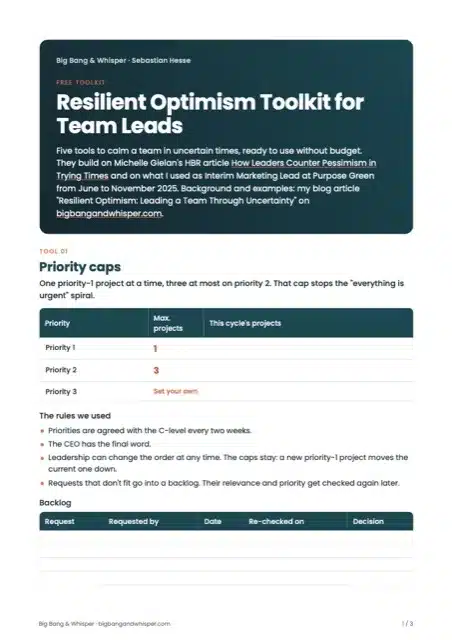
Resilient Optimism Toolkit for Team Leads
Five tools to calm a team in uncertain times, ready to use without budget.
3 pages · 99 KB · English
Pessimism is a reaction, not a character flaw
Gielan’s starting point: when a team gets hit by negative news, failures and uncertainty for a long time, people learn that their effort makes no difference. Psychologists call this learned helplessness. Engagement, energy and performance erode. In the worst case, the result is burnout.
The usual leadership reflex makes it worse. A “good vibes only” all-hands or a forced smile in the weekly meeting asks people to perform a mood they don’t feel. That costs energy they no longer have.
Gielan’s alternative is resilient optimism: you name the hard facts openly and still hold on to the belief that your actions can change the outcome. Both halves are needed. My reading: realism without agency turns into cynicism. Agency without realism sounds like a sales pitch.
Shift 1: Model the baseline
Gielan’s first lever is the leader’s own behavior. She names three things to model: point attention toward purpose and progress, prioritize visibly instead of spreading urgency, and treat recovery as part of sustainable performance.
What this looks like in practice
- Thank people for specific things. “Great job, everyone” is easy to forget. “The data set you cleaned on Tuesday saved us two days” stays.
- Stop calling everything urgent. If five tasks are “top priority”, none of them is. Say out loud which two things count this week and which ones can wait.
- Take breaks where people can see them. Log off at a normal hour. Take the lunch break. If the lead answers Slack at 11 p.m., the team hears a different message than the one in the policy.
At Purpose Green
One of the first things I did was to set up project management that everyone could read: where we stand and what comes next. With the C-level, I agreed on a fixed priority system. There could be exactly one priority-1 project at a time, a maximum of three priority-2 projects, and a few more at priority 3. Leadership could still override the order, but the caps stayed, so we never ended up with several “top priorities” at once. For requests from other departments, I introduced a marketing briefing form. It gave every team a clear way to reach marketing and replaced much of the ad-hoc traffic. This boundary toward the leadership team calmed things down in marketing. The team could focus on its work and deliver on time.
Shift 2: Reframe the stress
Gielan suggests treating stress as information about what people care about: a “signal check” asks what the pressure points to, instead of only how to make it stop. A team that is stressed about a campaign deadline cares about the result. That is something to work with.
The second tool is “Yes, and” language, known from improv theatre. The first half accepts the setback without spin. The second half moves straight to what the team can do next.
| Instead of | Try |
|---|---|
| “It’s not that bad.” | “Yes, the launch missed its target, and here’s how we collect feedback to relaunch smarter.” |
| “We just need to push harder.” | “Yes, the budget is smaller this quarter, and that tells us which two channels to focus on.” |
| “Let’s stay positive.” | “Yes, this week was rough, and we still shipped X. What’s the one thing that would make next week easier?” |
At Purpose Green
In 2025 we ran a Meta campaign that brought in a large number of MQLs. On paper it looked like a success. In practice, the lead quality was not good enough. Our “Yes, and” went like this: yes, the campaign missed its real goal, and it taught our performance marketing a lesson worth having. As a next step, we changed the targeting and reworked the lead form.
Shift 3: Supply positive dots
According to Gielan, the brain tends to string negative events into a hopeless story: one missed deadline, one tough board meeting, one lost deal, and the team concludes “nothing works here”. Gielan’s answer is to give people evidence for a different story. Praise, small acts of support and renewed connection show them that their work still moves things.
What this looks like in practice
- Collect small wins on purpose. A five-minute “what moved this week” round at the start of the team meeting. Write the wins down, so they are still there on a bad day.
- Spread positive gossip. Tell other teams and leadership about a colleague’s quiet work, and make sure the colleague hears about it.
- Remove small frictions. A broken approval loop or a tool nobody can log into costs time and patience every day. Fixing it shows that problems get solved.
At Purpose Green
The team had real dots to point to. Within eight weeks of my start at Purpose Green in November 2024, our earned reach grew 50%. Over 2025, with zero paid media spend, we reached 450+ media mentions, more than 100 million total reach and an advertising value equivalent of more than €4 million (Landau Media). Behind it was a data-driven content approach: together with our PR agency, we used scraped public data and analytics to generate earned media at scale.
We made these wins visible in two places. The Slack channel #all_news showed each result as it came in, open to our team and to the entire company. And every Monday morning, the weekly kick-off started with the highlights of the past week. We also shared the status of running campaigns and showed marketing designs that were still in the making. That kept everyone involved in the work while it was taking shape, before anything was finished.
Free toolkit · PDF
Resilient Optimism Toolkit for Team Leads
Five tools to calm a team in uncertain times, ready to use without budget: priority caps, project structure, Monday kick-off, “Yes, and” cheat sheet and a two-week checklist.
3 pages · PDF · 99 KB · English
Your next two weeks: a starter checklist
None of this needs a budget or an HR program. It needs a lead who does it consistently.
- Cut your team’s priority list to the two items that count this week and say so in the next meeting.
- Send one specific thank-you per day, naming what the person did and what it changed.
- Block a visible lunch break in your calendar and take it.
- Rephrase the next setback with “Yes, and”: state the fact, then the next step.
- Open each team meeting with five minutes on what moved since the last one.
- Tell one person outside your team about a colleague’s quiet work.
- Ask the team for the one small friction that annoys them most, and fix it within a week.
Gielan’s argument, as I read it: optimism in a team grows from evidence that action still works. A lead’s job is to make that evidence visible.
How do you keep your team going when the news is bad? I’d like to hear it on LinkedIn.