
The marketing OS – Content Engine · Part 1 of 6
Most marketing teams do not lack effort, tools or AI. They lack a clear answer to one question: who decides what, and when?
This article opens a series about the marketing OS, a way of organising marketing work in which machines prepare and named people decide.
Free playbook · PDF
Content Engine: the human-in-the-loop marketing OS
 How to run marketing content with AI while keeping people in charge, with templates to start from.
62 pages · PDF · 5.1 MB · English
Busy teams, little impact
Marketing teams publish on more channels and in more formats than ever, often with the same number of people. Everyone is busy, and yet too little of the work lands.

Four disciplines, four plans, one audience. (Illustration: Midjourney / Sebastian Hesse)
In my experience, effort is rarely the problem. The way the work is organised is. PR, marketing, events and design often plan side by side, each with its own plan and its own channels. The question in the room becomes “What could we post on this channel?” instead of “What do we have to say, and to whom?” I have seen this in my own team: four disciplines, four plans, one audience.
Silos are not a sign of a bad team. The journalist and anthropologist Gillian Tett sees them as a necessary consequence of scale and complexity, and warns that over time people become invested in defending the borders between them (Barnett, 2015). Generative AI adds more silos to every team: everyone opens their own chatbot, writes their own prompts and keeps their own context. Nothing connects the drafts to a plan, a voice or a decision.
The cost of a missing brief
When every discipline plans for itself, nobody writes the brief for everyone. That is expensive. In a global study of more than 1,700 marketers and agency staff, 80% of marketers said they write good briefs; only 10% of agencies agreed. Respondents estimated that a third of marketing budgets is wasted on poor briefs and misdirected work (Madigan, 2021).
Project research points the same way. In a survey of nearly 10,000 project professionals, projects that defined their success criteria before work started reached a net success score of 41, against 20 for projects that did not (Project Management Institute, 2024).
AI makes a missing brief more expensive, not less. It produces drafts faster than any team can check them, and without a brief there is nothing to check them against. A field experiment with consultants found that AI improved work on tasks inside its capabilities, but made people more likely to get it wrong on tasks outside them (Dell’Acqua et al., 2026). Every unbriefed draft becomes a review, and the reviews pile up with the few people who decide.
The real gap: nobody decides at the right moment
Silos, missing briefs and personal chatbots share one pattern: work moves on without anyone deciding at the right moment. In a silo, each discipline decides for itself, and nobody for the whole team. Without a brief, nobody decided what a piece should achieve. A free slot in a channel plan means the calendar decided instead of the team. A draft from a personal chatbot means the machine decided what to say.
None of this is a tool problem. It needs a shared way of deciding what to say, who decides and when.
Human-in-the-loop as a leadership principle
The answer I use is a principle with a long history: human-in-the-loop. The term comes from control engineering, where the human operator was treated as one part of a control loop. Today it mostly stands for human oversight of AI. Google’s guidance for AI agents, for example, asks for a well-defined human controller and explicit human confirmation for critical actions (Díaz, Kern and Olive, 2025).
I use it in a more specific sense. The machine prepares, and at fixed points a named person decides. Nothing moves from one step to the next without that decision. The points are known in advance, each has an owner, and each decision has more than one possible outcome: approve, change, send back, reject or park.
That makes human-in-the-loop more than a safety net for AI. It is a leadership principle. It defines who decides what, when and on what basis. And it applies to the team before any AI is involved: a topic is proposed, briefed, drafted, released and reviewed, and every handover is a fixed point with a named owner.
The marketing OS: one base, one governance, many modules
To hold team and machine together, the playbook describes a framework I call the marketing OS, short for marketing operating system. It has three levels.
The base is shared by everyone: one workspace in which the whole team plans and works, and one context that every piece of work draws on, from the personas and the positioning to the tone of voice, the facts and the lessons learned.
The governance sets the principles for everything built on the base. Three of them hold for every module: the machine prepares and a named person decides; every check has an owner, chosen by the type of risk; and every module draws on the same shared context.
The modules do the work. Each module prepares one kind of work and breaks the principles down into its own rules: who decides what, at which point and by when.
This separation is deliberate. Tools change faster than the way a team decides. When an AI model or a database is replaced, the principles and the approval owners should not have to change with it. A new module needs no new principles, only its own breakdown of them. That is why this series is built module by module: each playbook describes one module of the same marketing OS.
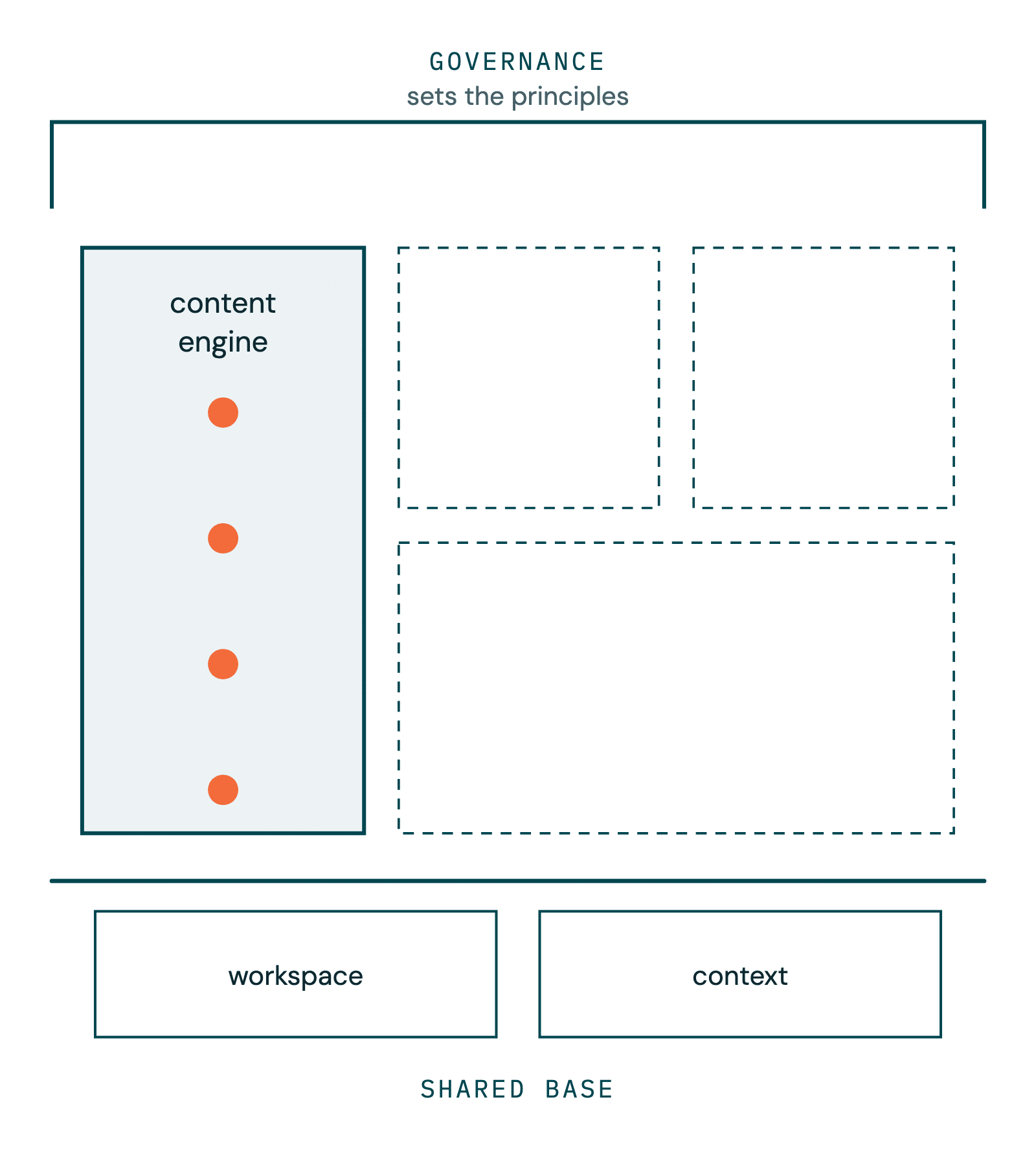
The marketing OS: one shared base, one governance, many modules.
The first module: the content engine
The first playbook describes the content engine: the module that runs a team’s content with AI while keeping people in charge. It has three layers.
- The channel layer is where things come in (newsletters, reports, articles) and where they go out (social media posts, blog articles, a newsletter).
- The content layer holds four stations on a loop: research finds what is worth saying, production drafts it, distribution prepares it for publication, and analytics measures what landed.
- The context layer holds four stores that keep learning: a knowledge base, the voice and the facts, the audience, and a learnings log.
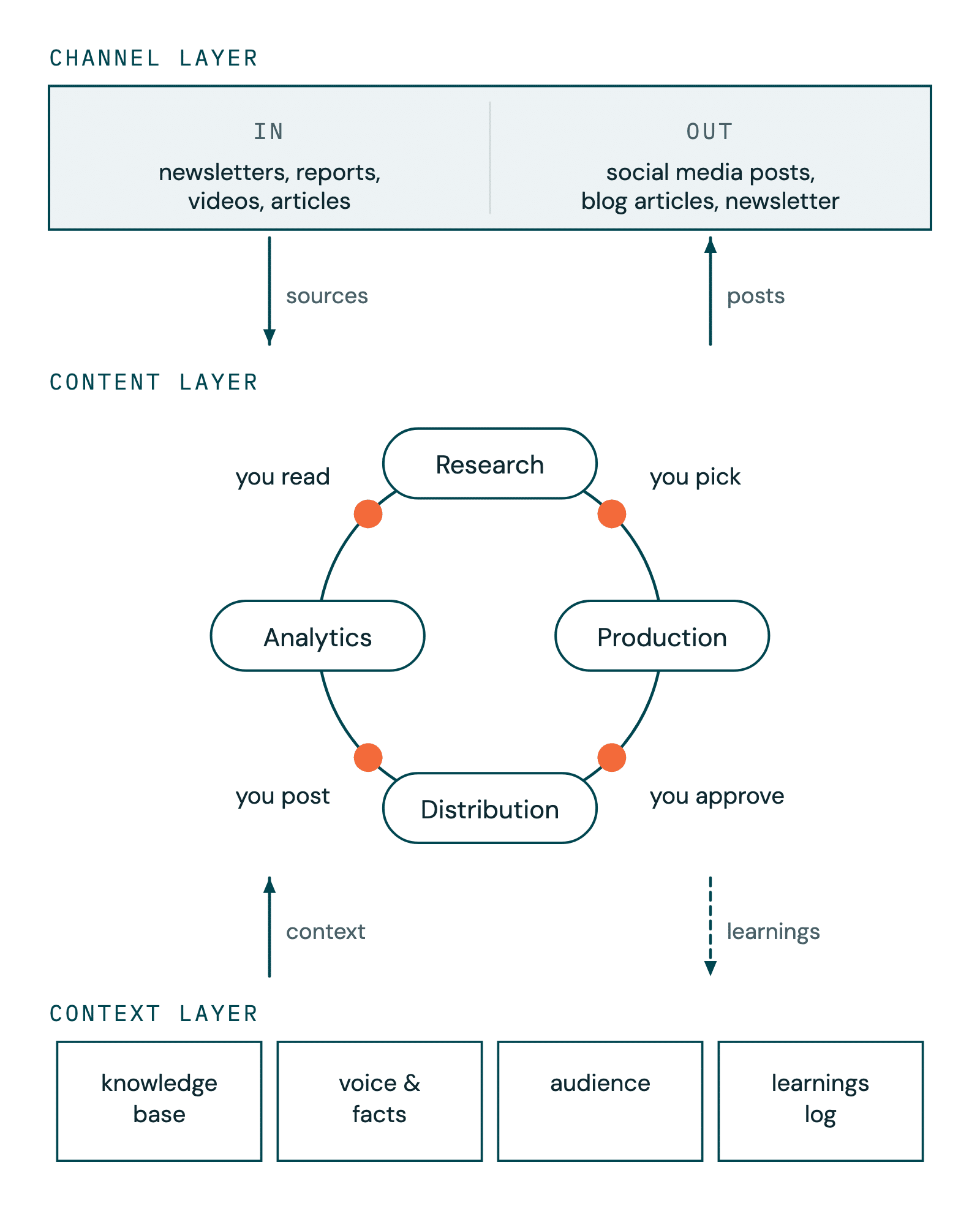
The content engine: three layers, four stations, and a person at every checkpoint.
Between the stations sit four checkpoints: you pick, you approve, you post, you read. On every turn, the loop passes a person four times. The machine researches, drafts and gathers results. People decide which idea is worth pursuing, whether a draft may go out, when and where it is posted, and what the results mean.
Why draw the line there? Because a person answers for what the team publishes. A model cannot be held to account for a wrong figure or a harmful claim; the person whose name is on the piece can. And people and machines do not get better results just because they work together. A meta-analysis of more than a hundred experiments found that human–AI combinations, on average, performed worse than the better of the two working alone; gains appeared mainly in tasks that involve creating content (Vaccaro, Almaatouq and Malone, 2024). Whether the gains appear depends on who does what. The roles have to be designed.
Decide how you decide, then automate
This leads to the order the playbook follows. Being AI-first does not mean starting with AI. It means considering AI for every process, and asking one question of each task: should the machine prepare it, should a person decide it, or both? Governance answers that question before any AI is switched on.
So the playbook starts with governance: planning from the company’s objectives down to the channel, written standards, approval owners by type of risk, clear rules for AI and one weekly editorial conference. Then comes a shared workspace in which all the work is visible. Only then comes the content engine, one station at a time. A team can work through these three steps in about 90 days, with the whole team involved.
For a team lead, this gives a team direction and alignment, clear decision rights and fewer bottlenecks. For a practitioner, it is a blueprint that can be rebuilt with whatever tools the team already uses.
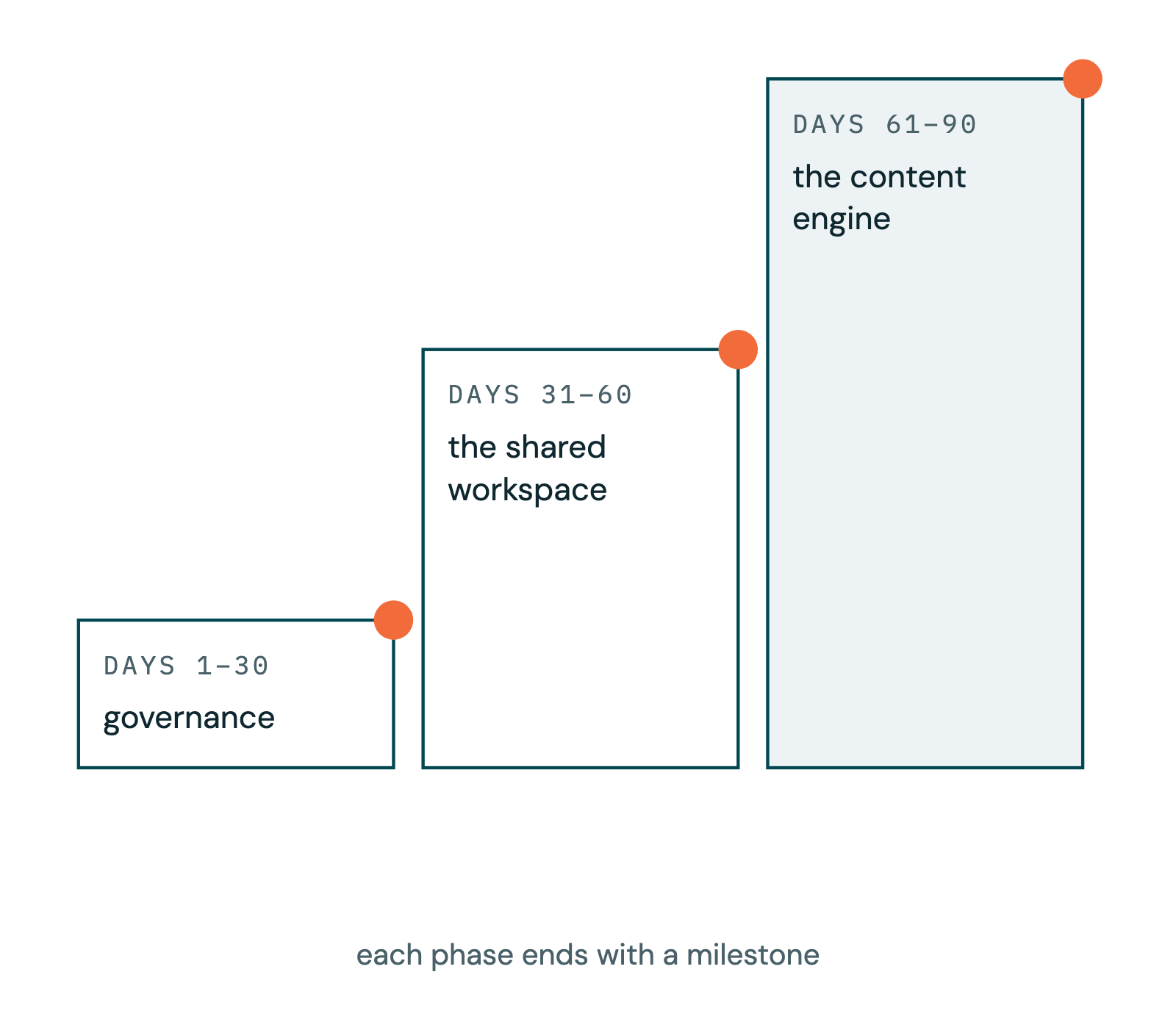
Decide how you decide, then automate: the first 90 days.
Free playbook · PDF
Content Engine: the human-in-the-loop marketing OS
Read the whole playbook: the governance, the content engine at work, how a team runs it, the first 90 days and templates to start from. Free, no form.
62 pages · PDF · 5.1 MB · English
What this series covers
The next five articles follow the playbook:
- Topic first: planning content from the company’s objectives down, and letting the product answer the audience’s questions.
- Approval by type of risk: why not every approval belongs at the top, and five rules for using AI.
- One meeting, named owners: how a team runs the system week by week.
- Inside the content engine: why the context comes before the content, and how each station works.
- The first 90 days: decide how you decide, and automate last.
Sources
- Barnett, P. (2015) ‘Breaking bad barriers’, strategy+business, 20 Oct.
- Dell’Acqua, F. et al. (2026) ‘Navigating the jagged technological frontier’, Organization Science, 37(2), pp. 403–423.
- Díaz, S., Kern, C. and Olive, K. (2025) Google’s approach for secure AI agents: an introduction. Google.
- Madigan, M. (2021) ‘The BetterBriefs Project finds 33% of marketing budgets wasted due to poor briefs’, B&T, 13 Oct.
- Project Management Institute (2024) Maximizing project success.
- Vaccaro, M., Almaatouq, A. and Malone, T. (2024) ‘When combinations of humans and AI are useful’, Nature Human Behaviour, 8(12), pp. 2293–2303.