The marketing OS – Content Engine · Part 3 of 6
Most content does not get stuck while it is being written. It gets stuck while it waits for a yes. In my team, that was complex content, such as political topics around regulation or case studies from client projects, sitting in the inbox at the top. The Content Engine Playbook answers with a simple rule: split approval by type of risk, give each check its own owner, and let one role release the piece. With AI producing drafts faster than anyone can read them, the same rule decides what an AI model may do and what stays with people.
Free playbook · PDF
Content Engine: the human-in-the-loop marketing OS
 How to run marketing content with AI while keeping people in charge, with templates to start from.
62 pages · PDF · 5.5 MB · English
Where content waits
Ask a content team where its pieces lose time, and the answer is rarely “writing”. A draft is ready on Tuesday. Then it goes to someone senior, who has forty other things on their desk. On Friday it comes back with a comment on the headline, and the fact check still has not happened, because nobody was asked to do it.
Without rules, approval becomes a favour someone does when they find the time. With rules, it becomes a step in the process that everyone can plan around.
Six building blocks
Whatever the size of the team, an approval process needs the same six parts:
- An owner for each type of check, named by role, not by name.
- Criteria: what is checked, and the one question the check answers.
- A sequence: who checks first, and who gives the final release.
- A deadline for every approval.
- A record of every decision, visible to the whole team.
- An escalation rule for the day an approval does not come in time.
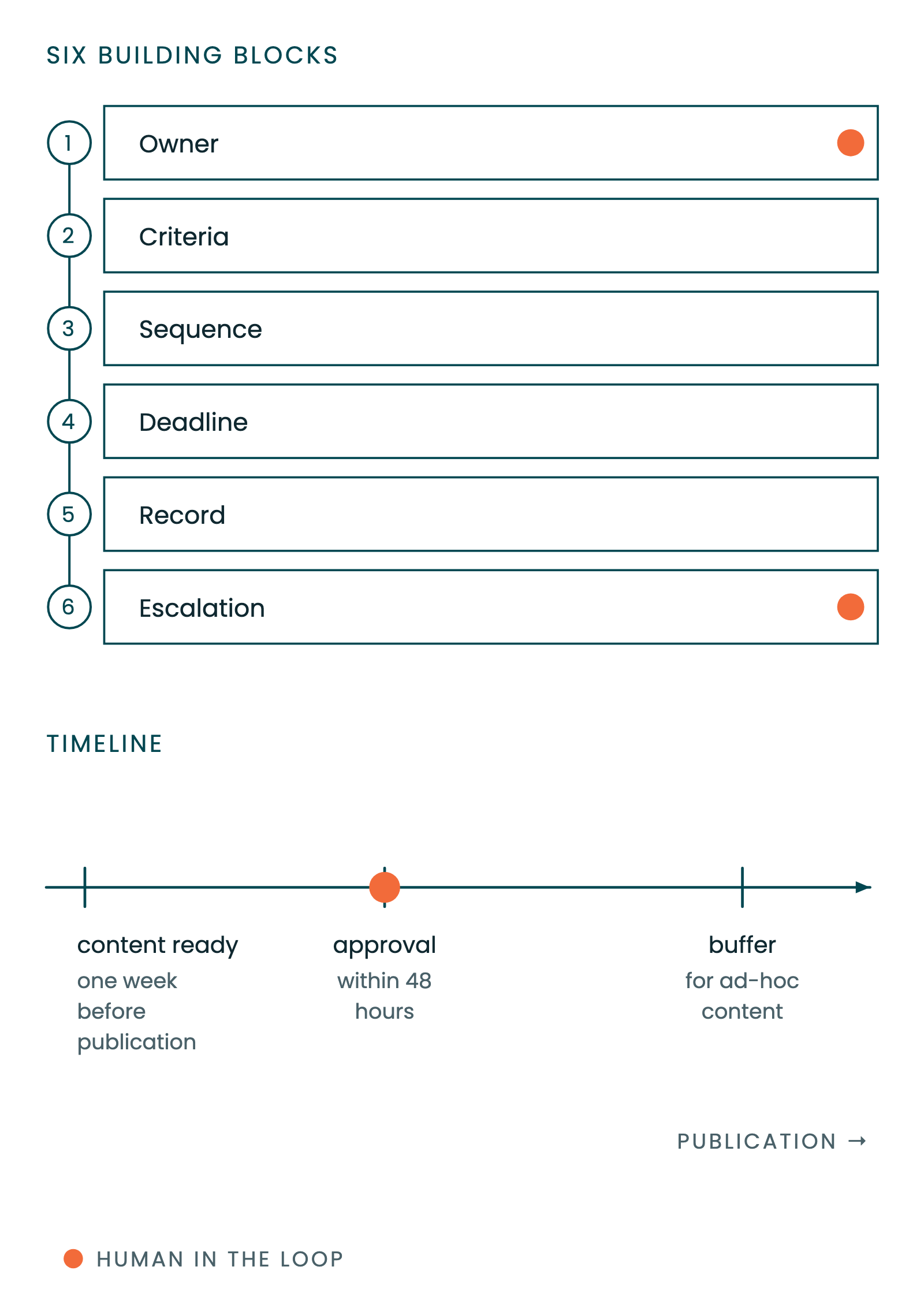
The six building blocks, and the timeline we worked to. The orange dots mark where a person decides.
Two safeguards keep these blocks honest.
The first comes from information security. It is called separation of duties: no single person should hold enough rights to misuse a system on their own.[1] For content, the translation is short. Whoever writes a piece does not approve it alone.
The second safeguard is timing. Jennifer Lerner and Philip Tetlock reviewed the research on accountability and found that it leads to careful, self-critical thinking mainly under one condition: people know before they make up their minds that they will have to justify their view, to an audience whose opinion they do not know and whose interest in their reasons they see as legitimate, among other conditions. If accountability arrives only after the decision, people tend to defend what they already did.[2] Even under the right conditions, the effect on the quality of judgement varies.
So the reviewers are set in the content plan, before anyone starts writing. The author knows from day one who will check what, and writes for that check.
In practice
In my team, a piece was ideally ready a week before its publication date and then only waited for approval. Within that week, we aimed to give every approval within 48 hours. The buffer left room for ad-hoc content that had to be written and approved at once. Every approval was recorded in our shared workspace. We set the process up as an automation in Notion: once a piece was approved, the author got a notification and the label in the content calendar changed to “to be published”.
Split approval by type of risk
Not every check asks the same question, so not every check needs the same person. In my team, we split approval by the kind of risk a piece carries:
| What is checked | The question | Who approves |
|---|---|---|
| Facts and complex or scientific content | “Is it true?” | Subject matter experts, and only they |
| Tone of voice and brand | “Does it sound like us?” | The communications lead |
| Quotes | “Can leadership say this?” | The CEO |
| Final release | “Is it ready to be published?” | The chief on duty, after all other approvals |
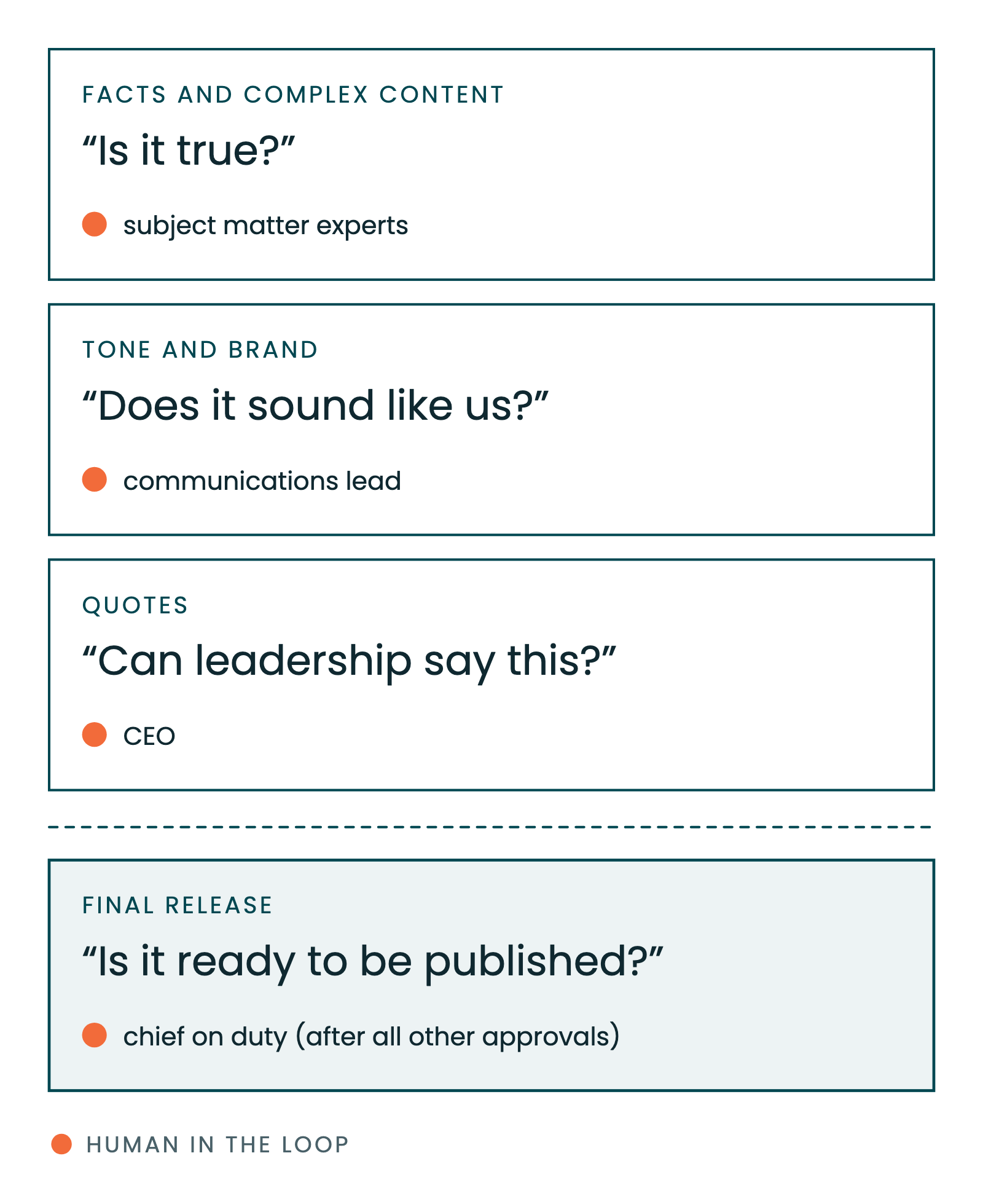
One question per check, one owner per question. The final release comes last.
The picture I use for this comes from a rocket launch. Before the final countdown, NASA’s launch manager polls every party involved, and each one says “Go” or “Ready” for its own area. Only then does the launch manager give the final go.[3]
In practice
At Purpose Green, as communications lead, I approved everything about language. Content and facts were approved by the subject matter experts, quotes by the CEO. As chief on duty, I gave the final release before anything went online.
Free checklist · A4 to print
Content release checklist
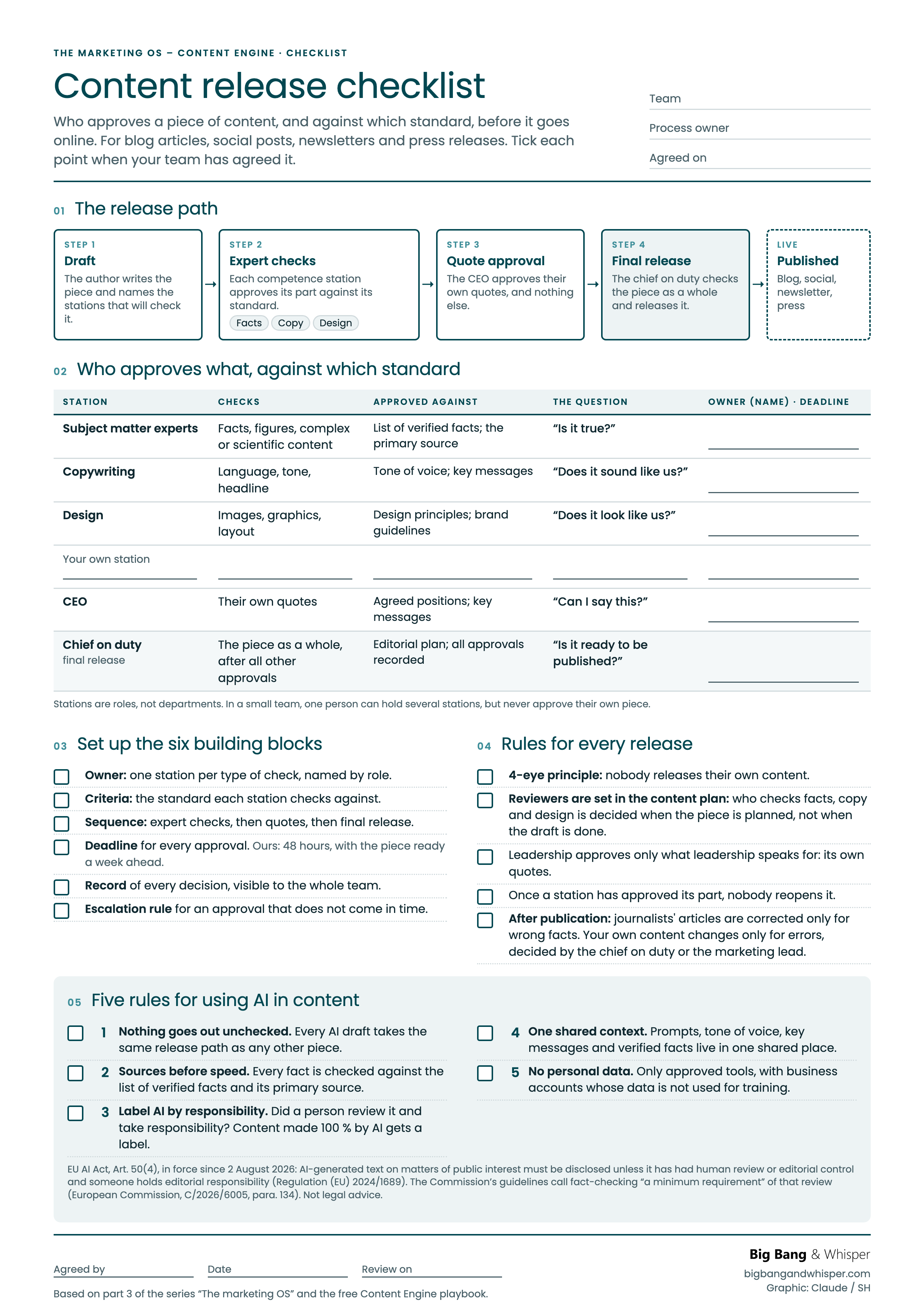 One page to print and fill in with your team: the release path from draft to final release, which station approves what against which standard (facts, tone of voice, design principles), the 4-eye principle and the five rules for using AI. See it at the end of this article.
1 page · A4 · PNG, 300 dpi · 0.8 MB · English
Readers of part 2 will remember the corporate newsroom model by Christoph Moss. On this point the playbook departs from it. The model’s standard process has a single approval step, in which the business unit approves the base document.[4] For a team that publishes science-heavy content, one approval step would have mixed questions that need different people to answer them. In the model, the strategy team also holds the final decision on all questions of content.[5] In the playbook, that work is split: the strategy team decides the quarterly focal topics, and the chief on duty releases each piece.
Why the split works: trust has a domain
Trust research gives the reason. Roger Mayer, James Davis and David Schoorman define trust as the willingness to rely on another party without being able to monitor or control them. They also point out that the ability we trust someone for is domain-specific: being very good at one task says little about another.[6]
A subject matter expert is the right person to judge a fact. A headline is a different task. A CEO is the right person to judge a quote, and probably the wrong person to judge the details of a regulation. So once an owner has answered their question, nobody reopens it. The chief on duty checks whether the piece works as a whole. The facts are already settled by the people who know them.
Not every approval belongs at the top
The lesson I would pass on to any team: do not route every approval to the top.
When each type of risk has its own owner, leadership signs off only what only leadership can speak for: its own quotes, its own positions. Everything else goes to owners who are trusted to decide, and pieces stop queuing in one inbox. However many specialists have approved a piece, one role still releases it: the chief on duty, who sees the piece as a whole before it goes online.

The trusted owner: one person who decides for one type of risk.
Speed is one reason. Paul Rogers and Marcia Blenko of Bain & Company wrote in Harvard Business Review that when it is unclear who decides, “decisions routinely get stuck inside the organization”.[7] Research on empowerment adds a second reason. A meta-analysis links psychological empowerment with higher task performance, and team empowerment with higher team performance.[8] Another meta-analysis finds that leaders who hand over responsibility see better performance and more creativity, in individuals and in teams. At the individual level, part of the effect on task performance runs through trust: people trust these leaders more.[9] These studies show correlations, not proof of cause, but they all point the same way.
Clear ownership also protects against a familiar trap. A third meta-analysis links unclear roles with lower job performance.[10] When “everyone” approves a piece, nobody is accountable for it.
After publication: who may change a piece?
Approval ends with the release. The question of ownership does not. Once a piece is out, the question changes from “who approves it?” to “who may change it?”. Without a rule, the answer is whoever is most senior, and every published piece stays open for revision.
The first thing to settle is who owns the content. Communications teams sort media by exactly that question. The PESO model, created by Gini Dietrich, distinguishes paid, earned, shared and owned media.[11] Two of them decide how a change request is handled.
Earned media, such as an article by a journalist, belongs to the newsroom that published it. It is the journalist’s work, and the company has no say over its wording. Newsrooms correct their own mistakes: in Germany, the press code obliges a publication to correct a report that turns out to be false.[12] So if a fact is wrong, PR can and should ask for a correction. If a sentence is merely not to someone’s taste, the article stays as it is. Asking a newsroom to change it questions its independence and puts the relationship PR has built at risk.
Owned content is the company’s own: posts, blog articles, newsletters. Here, errors should be fixed, and everyone in the team should point them out. But a published piece should not be revised again and again. Each change needs a reason, and a preference is not one. That is why the decision has an owner: the chief on duty or the marketing lead decides whether a published piece on an owned channel is changed. The most senior reader does not. The CEO’s moment of control comes earlier, when they approve their own quotes before publication.
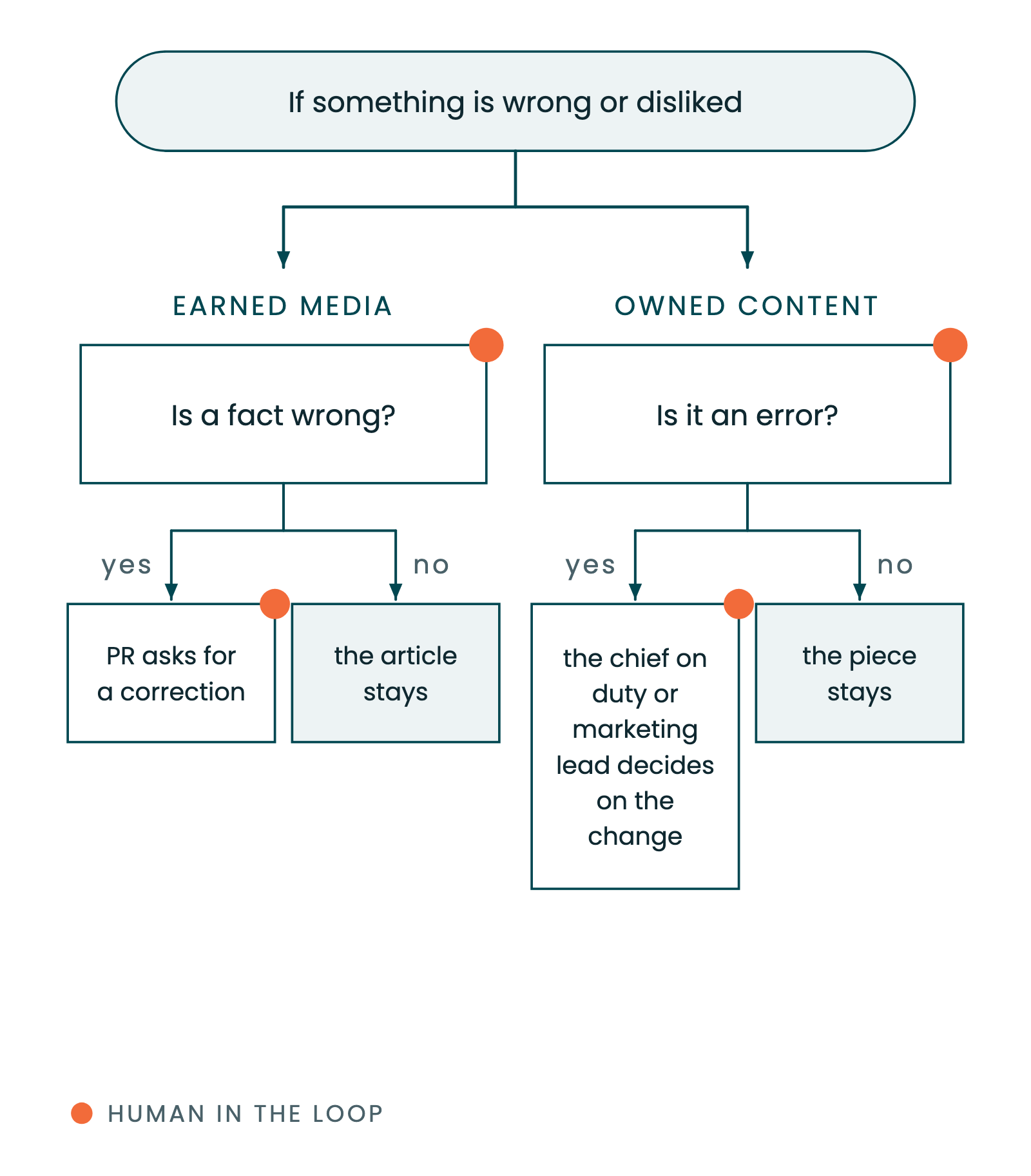
Two questions after publication. Earned media: is a fact wrong? Owned content: is it an error?
In practice
Several times in my career, a CEO asked whether we could call the journalist and have an article changed, because one sentence was not quite to their taste. The distinction between earned and owned media gave a clear answer: the article belongs to the newsroom, which corrects factual errors, not matters of taste.
Five rules for using AI
Everything above was true before generative AI. What AI changes is volume. A model can produce a dozen drafts before the first approver has opened their inbox. That makes the approval process the place where a team decides how it uses AI.
A marketing team that wants to be AI-first has to use AI, openly and every day. Banning it does not stop it. It moves the use into private chatbots, where nobody sees the prompts, the sources or the drafts.
The German news agency dpa took the same view when it published its guidelines for AI. Its first guideline is openness: dpa uses AI and is open to using more of it. Its second guideline sets the condition: “dpa only uses AI under human supervision.”[13] That is human-in-the-loop, written down by a newsroom. For a marketing team, I turn that condition into five rules.
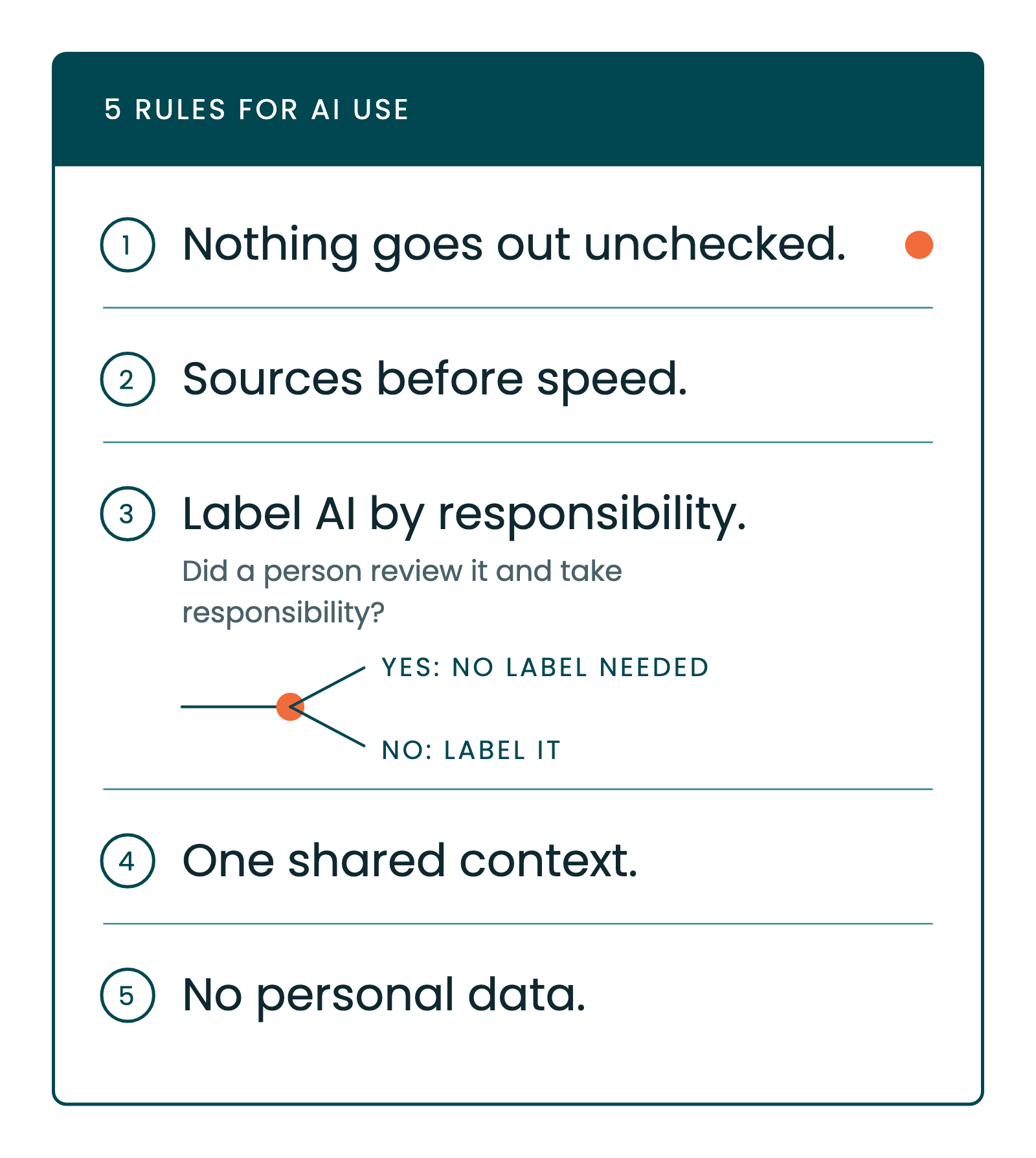
Five rules for AI use. The orange dots mark the human check and the labelling decision.
1. Nothing goes out unchecked. Every AI draft passes the people responsible for it: first the author, then the owner of each check from the table above. The model prepares. It never publishes.
2. Sources before speed. The biggest risks of AI in content are unchecked sources and invented facts. A model phrases a wrong figure as confidently as a right one. So every fact in an AI draft is checked against the team’s list of verified facts and against its primary source, as with any other draft.
3. Label AI by responsibility. Today, almost every piece of content gets some help from AI: a first draft, a summary, a headline. A label on every piece would tell the reader little. The useful question is whether a person checked the piece and takes responsibility for it.
European law draws the line in the same place. Under Article 50(4) of the EU AI Act, AI-generated text published to inform the public on matters of public interest has to be disclosed. The obligation does not apply where the content “has undergone a process of human review or editorial control” and someone “holds editorial responsibility for the publication of the content”.[14] This rule has applied since 2 August 2026.[14] The Digital Omnibus on AI, adopted in July 2026, gave providers extra time for the technical marking of AI content but left this paragraph unchanged.[15]
The European Commission’s guidelines on Article 50, published in the Official Journal in November 2026, spell out what counts as review: “Fact-checking the accuracy of the content is a minimum requirement that should be part of that review.” Spell-checks, an editorial policy that exists only on paper, automated reviews and “cursory editorial approval without substantive engagement” do not count.[16] An approval process with named owners, a fact check and a recorded release is the kind of review the guidelines describe. This is not legal advice; every team should check what applies to it.
Where I draw the line myself: I would always label content that was produced 100 % by AI, with no person involved.
4. One shared context. Prompts, the tone of voice, the key messages and the verified facts live in one shared place, not in anyone’s private chat history. Everyone, and every AI model, works from the same standards. (Part 5 of this series goes deeper into that context.)
5. No personal data. Customer data and other personal data do not go into AI tools. The team uses only tools the company has approved, with business accounts whose data is not used to train the model.
In practice
In my team, AI was used openly; we were even asked to use it, to work more efficiently. We never published AI content without a person’s approval: the communications lead or a subject matter expert checked it, and the chief on duty released it. Customer data and personal data stayed out of AI tools, and nobody used a private account. We only used business accounts whose data was not used for training.
Where the content engine picks this up
In the content engine, machines prepare and people decide. The approval checkpoint is where the owners from the table above make their call, and the chief on duty releases the piece. The engine can draft, check sources against the fact list and flag open questions. It cannot answer “Is it true?” or “Can leadership say this?” on anyone’s behalf.
Settle who approves what before you automate anything. A team that knows its owners, deadlines and five AI rules can let a model draft. A team that does not will only have more drafts waiting for a yes.
The checklist to print
The release path and the approval stations on one A4 page. Each station approves its part against a standard the team has agreed, the CEO approves their own quotes, and the chief on duty gives the final release. Tick each point when your team has agreed it.
Click the checklist to open the print version (A4, 300 dpi).
Free playbook · PDF
Content Engine: the human-in-the-loop marketing OS
Read the whole playbook: the governance, the content engine at work, how a team runs it, the first 90 days and templates to start from. Free, no form.
62 pages · PDF · 5.5 MB · English
What this series covers
- Machines prepare, people decide: why an AI-first marketing team needs governance first.
- Topic first: planning content from the company’s objectives down, and letting the product answer the audience’s questions.
- Approval by type of risk: why not every approval belongs at the top, and five rules for using AI. (this article)
- One meeting, named owners: how a team runs the system week by week.
- Inside the content engine: why the context comes before the content, and how each station works.
- The first 90 days: decide how you decide, and automate last.
Sources
- National Institute of Standards and Technology (n.d.) ‘Separation of Duty (SOD)’. NIST Computer Security Resource Center Glossary. Available at: https://csrc.nist.gov/glossary/term/separation_of_duty (Accessed: 24 November 2026).
- Lerner, J.S. and Tetlock, P.E. (1999) ‘Accounting for the effects of accountability’, Psychological Bulletin, 125(2), pp. 255–275 (here pp. 257, 259). Available at: https://doi.org/10.1037/0033-2909.125.2.255 (Accessed: 24 November 2026).
- NASA (2005) NPD 8610.24C: Launch Services Program Pre-Launch Readiness Reviews (revalidated 2 April 2025 with Change 3), section 5.d(6). Washington, DC: National Aeronautics and Space Administration. Available at: https://explorers.larc.nasa.gov/APSMEX26/SMEX/pdf_files/N_PD_8610_024C_chg3.pdf (Accessed: 24 November 2026).
- Becker, N. (2026) ‘Der Standardprozess im Corporate Newsroom’. Mediamoss-Blog, 21 May 2026. Available at: https://mediamossblog.com/2026/05/21/der-standardprozess-im-corporate-newsroom/ (Accessed: 24 November 2026).
- Becker, N. (2026) ‘Die fünf Rollen im Corporate Newsroom’. Mediamoss-Blog, 21 May 2026. Available at: https://mediamossblog.com/2026/05/21/die-fuenf-rollen-im-corporate-newsroom/ (Accessed: 24 November 2026).
- Mayer, R.C., Davis, J.H. and Schoorman, F.D. (1995) ‘An integrative model of organizational trust’, Academy of Management Review, 20(3), pp. 709–734 (here pp. 712, 717). Available at: https://doi.org/10.5465/amr.1995.9508080335 (Accessed: 24 November 2026).
- Rogers, P. and Blenko, M.W. (2006) ‘Who has the D?: How clear decision roles enhance organizational performance’. Harvard Business Review, January 2006. Available at: https://hbr.org/2006/01/who-has-the-d-how-clear-decision-roles-enhance-organizational-performance (Accessed: 24 November 2026).
- Seibert, S.E., Wang, G. and Courtright, S.H. (2011) ‘Antecedents and consequences of psychological and team empowerment in organizations: a meta-analytic review’, Journal of Applied Psychology, 96(5), pp. 981–1003. Available at: https://doi.org/10.1037/a0022676 (Accessed: 24 November 2026).
- Lee, A., Willis, S. and Tian, A.W. (2018) ‘Empowering leadership: a meta-analytic examination of incremental contribution, mediation, and moderation’, Journal of Organizational Behavior, 39(3), pp. 306–325. Available at: https://doi.org/10.1002/job.2220 (Accessed: 24 November 2026).
- Gilboa, S., Shirom, A., Fried, Y. and Cooper, C. (2008) ‘A meta-analysis of work demand stressors and job performance: examining main and moderating effects’, Personnel Psychology, 61(2), pp. 227–271. Available at: https://eprints.lancs.ac.uk/id/eprint/45119 (Accessed: 24 November 2026).
- Spin Sucks (n.d.) ‘The PESO Model® — The MarComm Operating System’. Available at: https://spinsucks.com/peso-model/ (Accessed: 24 November 2026).
- Deutscher Presserat (2025) ‘Pressekodex: Ethische Standards für den Journalismus’. Version of 19 March 2025, Ziffer 3. Available at: https://www.presserat.de/pressekodex.html (Accessed: 24 November 2026).
- Raabe, S. (2023) ‘Offen, verantwortungsvoll und transparent – Die Guidelines der dpa für Künstliche Intelligenz’. dpa Innovation, 3 April 2023, updated 10 July 2024. Available at: https://innovation.dpa.com/2023/04/03/kuenstliche-intelligenz-fuenf-guidelines-der-dpa/ (Accessed: 24 November 2026).
- European Parliament and Council of the European Union (2024) ‘Regulation (EU) 2024/1689 of the European Parliament and of the Council of 13 June 2024 laying down harmonised rules on artificial intelligence (Artificial Intelligence Act)’, Articles 50(4) and 113. Official Journal of the European Union, L series, 12 July 2024. Available at: https://eur-lex.europa.eu/eli/reg/2024/1689/oj (Accessed: 24 November 2026).
- European Parliament and Council of the European Union (2026) ‘Regulation (EU) 2026/1744 of the European Parliament and of the Council of 8 July 2026 amending Regulations (EU) 2024/1689, (EU) 2018/1139 and (EU) 2023/1230 as regards the simplification of the implementation of harmonised rules on artificial intelligence (Digital Omnibus on AI)’. Official Journal of the European Union, L series, 24 July 2026. Available at: https://eur-lex.europa.eu/eli/reg/2026/1744/oj (Accessed: 24 November 2026).
- European Commission (2026) ‘Communication from the Commission – Guidelines on the implementation of the transparency obligations for certain AI systems under Article 50 of Regulation (EU) 2024/1689 (the ‘AI Act’) (C/2026/6005)’. Official Journal of the European Union, C series, 12 November 2026, paras. 134–135. Available at: https://eur-lex.europa.eu/legal-content/EN/TXT/HTML/?uri=OJ:C_202606005 (Accessed: 24 November 2026).