
The marketing OS – Content Engine · Part 2 of 6
Content planning often starts with a channel and ends with the question “What could we post here?” The Content Engine Playbook turns that order around: first the company’s objectives, then a few broad topics that belong to the business, then the questions the audience actually has, and only at the very end the channel.
It is the first thing a team should settle before it lets any AI produce content automatically.
Free playbook · PDF
Content Engine: the human-in-the-loop marketing OS
 How to run marketing content with AI while keeping people in charge, with templates to start from.
62 pages · PDF · 5.5 MB · English
Who is filling the slots?
Open almost any marketing calendar and you will find the same picture: one row per channel, a date grid, and a lot of empty cells. LinkedIn needs three posts this week. The newsletter goes out on Thursday. The blog has not had anything new for a fortnight. So someone sits down and asks the question every content team knows: what could we post on this channel?
It sounds harmless, but it quietly hands the agenda to the calendar. Each discipline fills its own cells, and the audience ends up hearing five different things from one company.
Generative AI makes this habit cheaper, not rarer. A model can fill an empty cell in seconds. If nobody has decided what the team wants to say, the machine will happily produce something for every slot, and no one will notice that nothing was decided.
In my team, we changed the order in which we planned. After that, nobody asked “What could we post here?” any more. The question had simply stopped making sense.
Begin with what the company wants, not with what marketing needs
The planning in the playbook does not start in marketing at all. It starts one level higher, with the objectives of the company, and works its way down in steps.
The first step sorts the content. A company usually works in a handful of broad fields it wants to be known for; the playbook calls them topic islands. Each island holds a few content pillars: themes the team returns to again and again, and that frame every campaign. Think of a software provider for small businesses. Data security could be one of its islands, with backups, access rights and compliance as pillars underneath.
The second step sets the focus. Every quarter, a small strategy team looks at the objectives and picks one focal topic for the next three months. It may sit inside one pillar or cut across several, and it is allowed to be very concrete, a product launch, for instance.
The third step makes the focal topic usable. The team asks what the focal topic means in the everyday life of its audience and turns that into individual topics. Every piece of content links back to one of them. Then the quarter is broken down into months and weeks, so the plan holds together.
Somewhere in this step the team also sets its rhythm: how often does a bigger highlight come out? For a small team, every two weeks is realistic without burning people out. A bigger team can manage one a week. And only after all of this does anyone talk about channels.
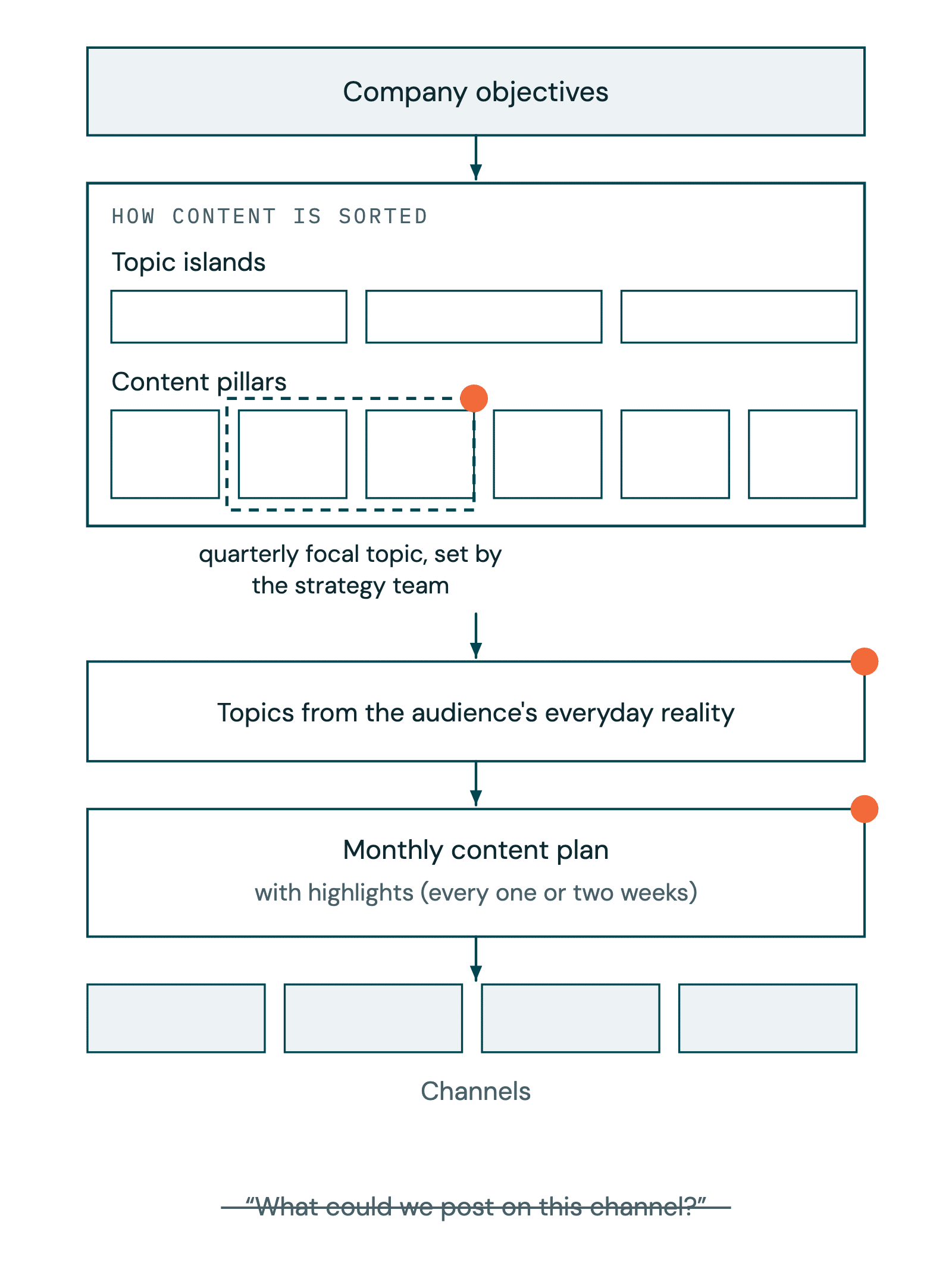
The planning cascade. Each orange dot is a decision a person makes: the focal topic, how it is broken down, what goes into the monthly plan.
Why shared goals beat channel goals
Why go to this trouble? Because it swaps many small channel goals for a few big shared ones, and that is where the research is surprisingly clear.
Edwin Locke and Gary Latham summarised some 35 years of goal-setting studies: people perform better when they work towards specific, demanding goals than when they are told to “do their best” (Locke and Latham, 2002). A meta-analysis on groups found the same effect for teams, with an important twist. Individual goals inside a team only helped when they were about each person’s contribution to the team. Goals about personal success made the team’s result worse (Kleingeld, van Mierlo and Arends, 2011).
Translated into marketing: the person who optimises “their” channel is chasing an individual goal. That is what a silo is. The cascade gives everyone the same few goals to look at and work towards.
There is a side effect that pays off in search, too. Google’s own starter guide points out that a site organised in a logical way helps both search engines and readers understand how its pages belong together (Google, 2025). Islands and pillars give a site exactly that shape: a clear structure with many pieces that link to each other.
A rule from the newsroom
A planning order is only as good as the people who defend it. For that part, I borrowed from journalism.
Christoph Moss, a professor who studied how newspaper editorial teams are organised for his doctorate, turned what he found into the corporate newsroom model (Mediamoss, no date). Its central rule fits into one line: first the topic, then the channel (Moss, no date). You decide what you have to say and to whom. How, where and when come afterwards.
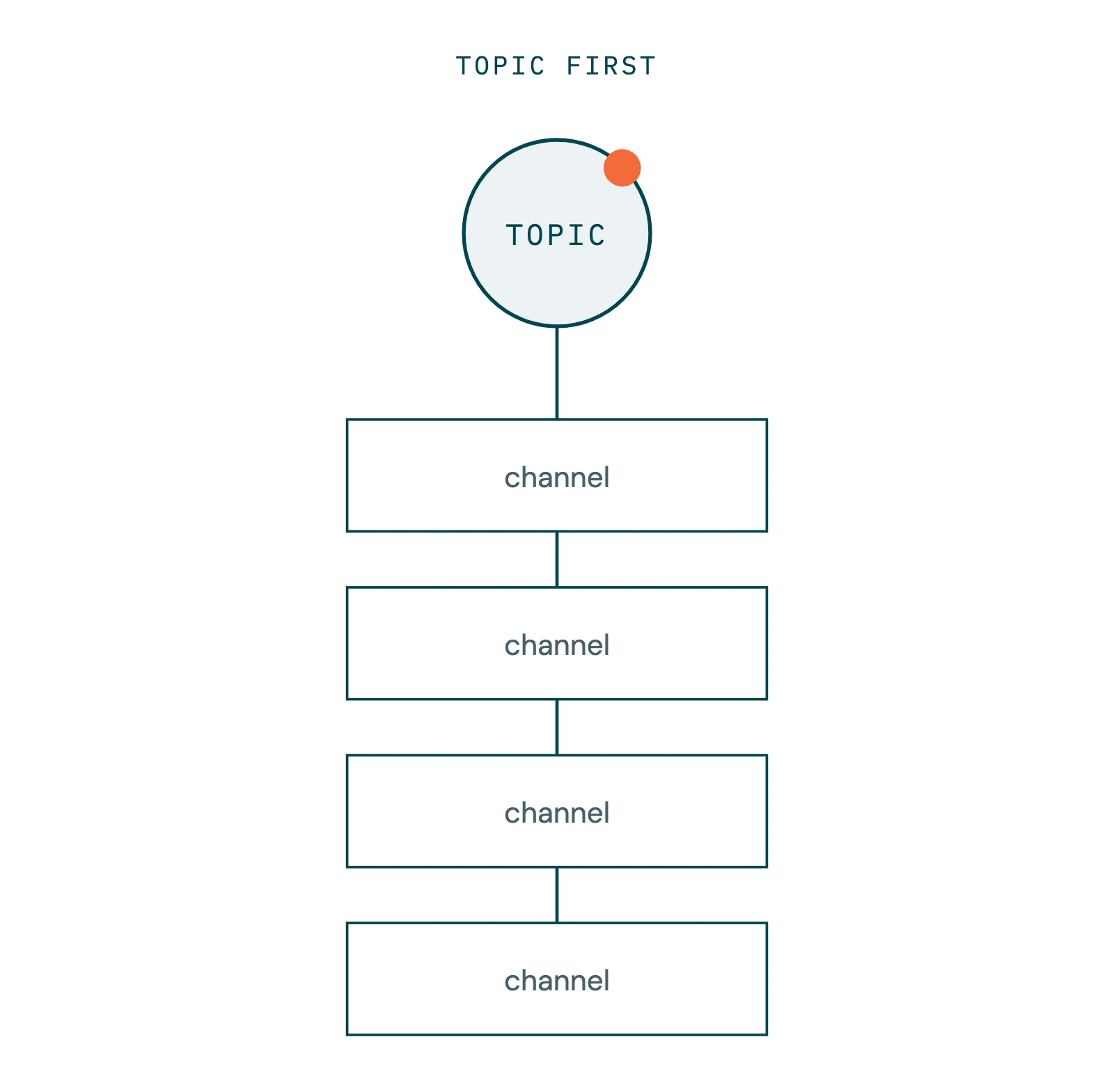
Topic first. The decision is made once, at the topic, and the channels follow.
To keep that rule alive, the model separates two jobs. One side looks after the topics and stays close to the business, so it knows what matters. The other side looks after the media and knows how to tell a story on each channel. In between sits a chief on duty, who sets priorities and runs the editorial conference. Above everything, a strategy team steers the topics and has the last word if content is disputed.
The work itself follows a fixed path. A topic is logged, assessed and scheduled in the editorial conference. It becomes a base document, gets approved, is adapted for each channel, goes out, and is finally measured against the goal it was meant to serve (Becker, 2026).
You do not need a big team for this
When I describe this model, the first reaction is often: “We are five people. We cannot have desks and a chief on duty.” Moss answers that himself. Whether you build a newsroom, he says, is not a question of how big your department is, but of attitude (Moss, no date).
I agree. A team that cannot fill every role can still decide on the topic before it thinks about the channel. That is a choice about how people work together, and it costs no headcount.
For the playbook, I adapted the model in four places:
- It covers the whole marketing team and its project management, not just communications.
- The desks are roles people take on, not departments with their own staff.
- Approval is split by type of risk, and the final release sits with the chief on duty. (More on that in part 3 of this series.)
- It adds the part a newsroom model from the pre-AI era could not cover: a content engine, in which machines prepare and named people decide.
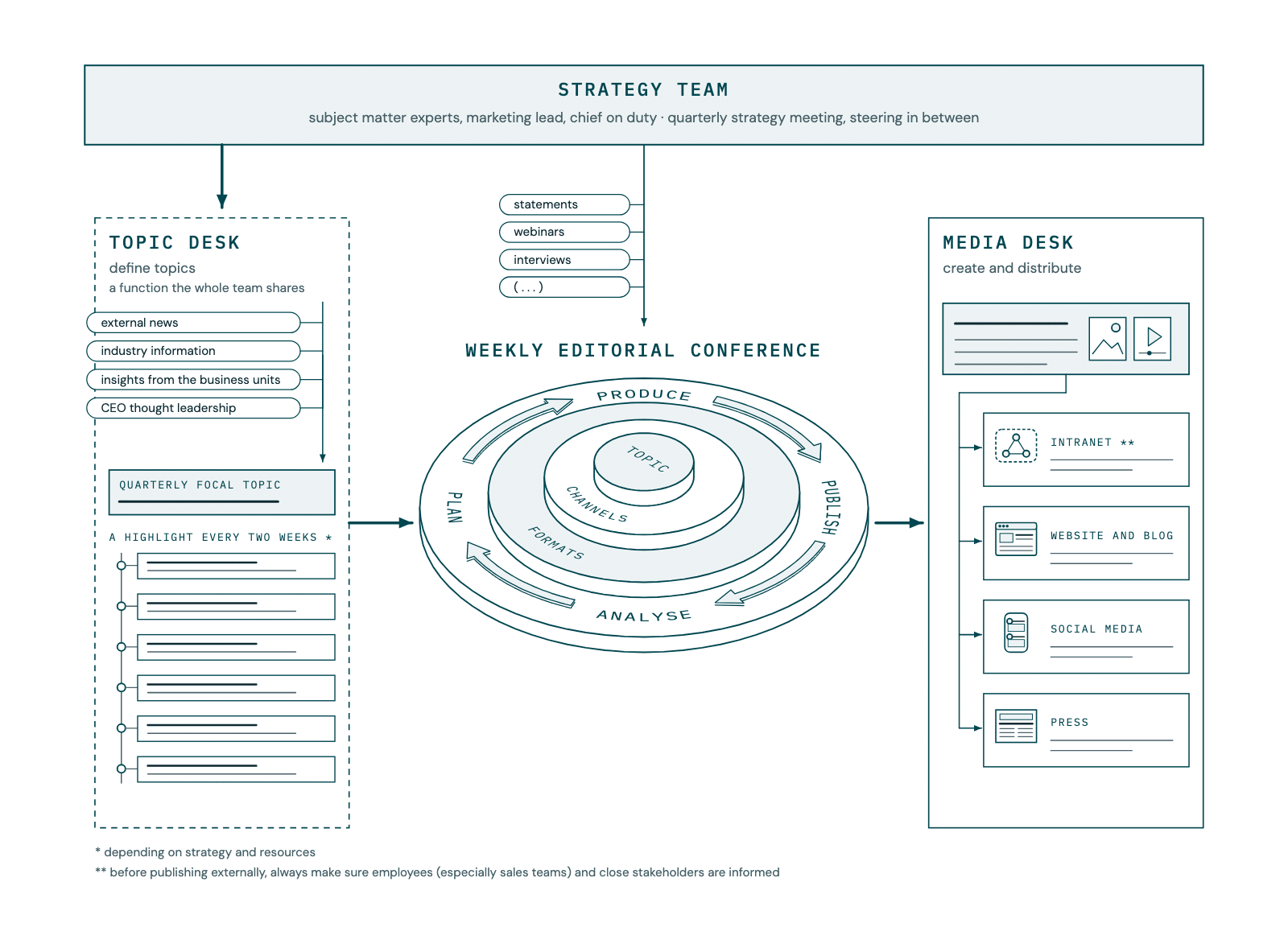
How the set-up looked in a team of ten. Nobody “owned” the topic desk; everyone fed it.
In practice
At Purpose Green, we ran the whole marketing operation this way: campaigns, tasks, design requests and workload, all in one shared workspace.
We were ten people. I led communications and was the chief on duty. Once a quarter, a strategy team met: subject matter experts, the marketing lead and me. We set the direction there and kept steering between meetings. We never had a separate topic desk. Instead, everyone brought in topics, from the news, from industry sources, from what the business units were learning and from the CEO’s thought leadership. The strategy team turned that into one focal topic per quarter. Depending on strategy and resources, that gave us a new highlight every two weeks. The media desk produced the content and published it in a fixed order: intranet first, then website and blog, social media and press.
Make the product the answer, not the headline
Here is a situation most B2B teams know. The focal topic for the quarter is a product launch. The obvious content almost writes itself: features, modules, pricing. The trouble is that all of it is about the company, and very little of it is for the reader.
The playbook asks the team to take a detour through the audience’s everyday life. What are these people responsible for? What slows them down? Which decisions are on their desk? Their questions become the topics. Each question gets its own piece, in the format that answers it best: a guide, an analysis, a checklist, a live talk. One channel acts as the hub, and the others are arranged around it.
The product is still in the story. It just shows up where it belongs: as the answer.
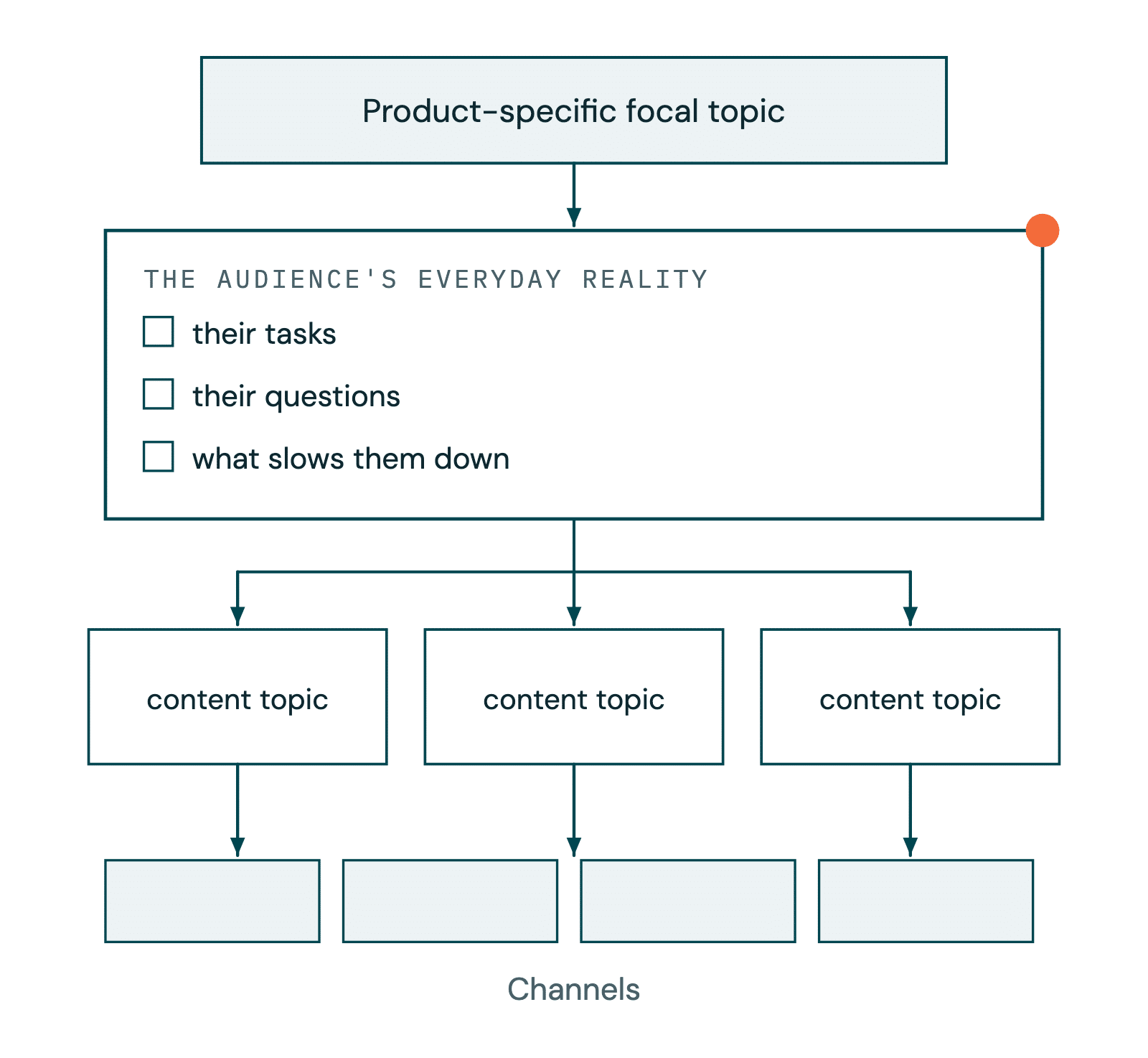
From product to topic. Which of the audience’s questions the team answers is a human decision.
In practice
One quarter at Purpose Green, the focal topic was the launch of a new software platform for ESG (environmental, social and governance) and renovation management in real estate. Our readers were ESG managers at mid-sized property owners. They wanted a single tool to see the ESG performance of an entire portfolio, but what kept them busy were very practical questions. How do I get from a portfolio analysis to a renovation roadmap? What will rising CO₂ prices cost my buildings, and who pays? Which funding programmes make a renovation worthwhile? We turned each question into its own piece: a guide, a data analysis of expected CO₂ costs, a checklist for funding and a live talk on whether renovating existing buildings pays off. The blog was the hub. Press work, events and the other channels were built around it.
Where AI comes in
You may have noticed that none of this needs AI. That is deliberate. The cascade has to exist before a model is switched on, because it is what tells the model what to work on.
Once it stands, a machine can take over a lot of the groundwork. In the content engine, a research step goes through the team’s knowledge base every working day and suggests a handful of topics. Each suggestion comes as a short dossier: what triggered it, the key facts and sources, a possible angle and an argument against it. Then a person decides: take it with a note, drop it or park it for later. What that person decides against are the islands and the focal topic.
The decisions that shape the cascade stay human: which focal topic the quarter serves, which of the audience’s questions the team takes on, which highlight goes out when. They are the orange dots in the diagrams above. A model can propose them. It cannot be held responsible for them.
Let the team say yes first
One last point, and for me the most important one. A planning model like this should not be handed down from the top.
Research on organisational change shows that people are more open to a change when they are informed about it and have a say in the decision (Wanberg and Banas, 2000). In practice, that means presenting the model before you roll it out. Put the problems the team itself has raised next to the solution you propose. Ask for their go. Build the shared workspace only after that.
That is how it went in my team. The problems came from the team. I showed them the corporate newsroom model, problem and solution side by side, and asked whether they wanted to work this way. Only after their yes, and with the go-ahead from management, did I start building.
A team that has chosen its planning model is a team that will actually use it.
Free playbook · PDF
Content Engine: the human-in-the-loop marketing OS
Read the whole playbook: the governance, the content engine at work, how a team runs it, the first 90 days and templates to start from. Free, no form.
62 pages · PDF · 5.5 MB · English
What this series covers
- Machines prepare, people decide: why an AI-first marketing team needs governance first.
- Topic first: planning content from the company’s objectives down, and letting the product answer the audience’s questions. (this article)
- Approval by type of risk: why not every approval belongs at the top, and five rules for using AI.
- One meeting, named owners: how a team runs the system week by week.
- Inside the content engine: why the context comes before the content, and how each station works.
- The first 90 days: decide how you decide, and automate last.
Sources
- Becker, N. (2026) ‘Der Standardprozess im Corporate Newsroom’, Mediamoss-Blog, 21 May.
- Google (2025) Search Engine Optimization (SEO) Starter Guide. Google Search Central.
- Kleingeld, A., van Mierlo, H. and Arends, L. (2011) ‘The effect of goal setting on group performance: a meta-analysis’, Journal of Applied Psychology, 96(6), pp. 1289–1304.
- Locke, E.A. and Latham, G.P. (2002) ‘Building a practically useful theory of goal setting and task motivation: a 35-year odyssey’, American Psychologist, 57(9), pp. 705–717.
- Mediamoss (no date) Der Newsroom beginnt im Kopf.
- Moss, C. (no date) ‘Corporate Newsroom: Zuerst das Thema, dann der Kanal’, GABAL Magazin.
- Wanberg, C.R. and Banas, J.T. (2000) ‘Predictors and outcomes of openness to changes in a reorganizing workplace’, Journal of Applied Psychology, 85(1), pp. 132–142.